
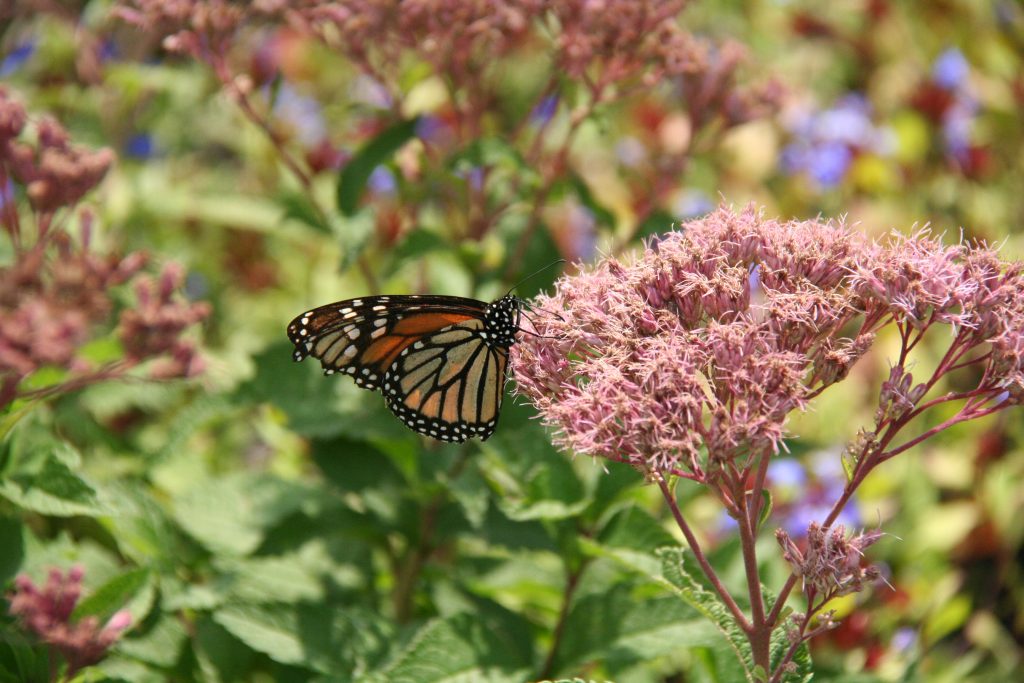
It all sounds great… pretty flowers, nice colors, relatively easy to grow, and attracts butterflies – winner winner! But wait. Before you go and plant that butterfly bush in the ground, let’s have a conversation.
Butterfly bush (Buddleia sp.) is native to China. While it’s a reasonable nectar source for butterflies, it is also an invasive species in many areas of the United States. For me, if it’s on an invasive species list, I’m going to avoid planting it. A post about invasive vs aggressive species is coming, but for now, know that invasive means it feeds nothing.
If you really want to attract, nurture, and feed butterflies and other pollinators, you have to feed not only the flashy, beautiful adults – you have to feed their children, the larvae (caterpillars).Caterpillars can not just eat anything you put in front of them. They are specialists – they’ve evolved alongside certain plants, and those are the only plants they can consume.
Sounds complicated, but it’s really quite simple: plant native species!
Here’s a list to get you started:
Asclepias (milkweeds) – The ultimate larval food for monarchs and an excellent nectar source. Yes, they come with orange aphids—do not freak out. Plant more milkweed.
Eutrochium maculatum (Joe Pye weed) – Talk about a butterfly magnet! It’s a larval food source for many moths—yes, moths! And moths aren’t just beautiful… What do you think baby birds eat?
Liatris (aspera, spicata, pycnostachya) – Yes, plant them all! It’s a smorgasbord for butterflies, bees, and other pollinators. Also a larval food source for several moth species. Again—baby birds don’t eat seeds!
Eryngium yuccifolium (rattlesnake master) – Plant it for the name alone and still reap the benefits. The flowers are fantastic for pollinators, it’s a larval food source for moths and butterflies, and the seeds feed birds!
Rudbeckia fulgida (black-eyed Susan) – A larval food source with ray flowers that attract bees and other pollinators. Plus, the seeds are great for birds. Talk about a productive planting!
Echinacea purpurea – Not the newfangled, double-decker sterile ones—stick with the good ol’ straight purple coneflower and native hybrids. Larval food, nectar source, and seed all in one.
Geranium maculatum (wild geranium) – A naturalizer that offers larval food, an early-season nectar source, and seeds consumed by birds and small mammals.
Agastache foeniculum (hyssop) – Another pollinator magnet! This plant is a flurry of activity in bloom. It truly has it all: nectar, larval food, and seeds that songbirds love.
Vernonia species (ironweed) – A fall-blooming powerhouse providing nectar, larval food, and seeds for songbirds. You’ll want this in every border.
Amsonia tabernaemontana, hubrichtii – An early-blooming nectar source that also provides larval food and seed. An absolute workhorse—tolerates a variety of soils and makes it look easy.
Lindera benzoin (spicebush) – Offers larval food, early nectar, and beautiful fall berries that birds love. Large enough to anchor a shrub border.
Quercus species (oaks) – Oaks support more species of moths and butterflies than any other plant genus. Want to truly support wildlife? Plant an oak—any native oak. Illinois has 26 native species. Plant them.
Sassafras albidum (common sassafras) – Brings fall color, early blooms, nectar, larval food, seed, and serves as an important nesting site.
Grasses (native bluestems—big and little, switchgrass, and prairie dropseed) – These provide seed sources and critical structure, offering safe places for caterpillars to form their chrysalises.